
 Português
Are new energy sprinkler trucks adaptable to various weather and road conditions?
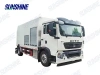
New energy sprinkler trucks have certain advantages in adapting to diverse weather and road conditions, but they also face challenges. Overall, with technological advances, new energy sprinkler trucks are gradually improving their performance in various complex environments. However, further improvement is still needed in extreme weather and specific road conditions. The following is an analysis of the adaptability of new energy sprinkler trucks in various weather and road conditions:
1. Performance in Rainy or Wet Weather
Adaptability: In rainy or humid conditions, the need for new energy sprinkler trucks is generally reduced, as rainwater itself has a cleansing effect. However, in certain situations, such as humid air or flooded roads, sprinkler trucks can still suppress airborne dust and pollutants through micro-spraying.
Challenges: During periods of sustained heavy rain, the sprinkler truck's water flow may need to be automatically adjusted to avoid conflict with natural precipitation. In these situations, intelligent water flow control systems can regulate water flow and avoid wasting water resources.
2. Performance in Drought or High Temperature Weather
Adaptability: The advantages of new energy sprinkler trucks are particularly evident in drought. Thanks to their precise water flow control system, they can conserve water and avoid excessive waste. Especially in urban green spaces or on highways, sprinkler trucks can help control dust, maintain air humidity, and improve road conditions.
Challenges: In extremely hot environments, sprinkler trucks may require increased water volume to mitigate dust caused by the heat, especially in areas prone to sandstorms. In these situations, the water recovery and circulation systems of new energy sprinkler trucks are particularly important, reducing water consumption.
3. Performance in Cold Weather
Adaptability: New energy sprinkler trucks also offer good adaptability in cold winters. They utilize temperature control systems to prevent the water pumps and nozzles from freezing. Advanced electric systems and battery technology generally maintain stable operation in low temperatures, ensuring the vehicles can complete their watering tasks.
Challenges: In extremely cold weather, if sprinkler trucks use aqueous solutions, they must use antifreeze to prevent the water pipes and nozzles from freezing. Furthermore, the battery life of new energy sprinkler trucks may be affected in extremely cold conditions, requiring specially designed insulation systems to extend battery life. 4. Performance in High Humidity or Haze
Adaptability: New energy sprinkler trucks also perform well in high humidity or haze weather. Haze can easily degrade air quality. New energy sprinkler trucks effectively suppress dust and airborne particulate matter through micro-spraying or ultra-fine spraying, thereby improving air quality.
Challenges: In very humid environments, the water flow of sprinkler trucks may require more precise control to prevent water accumulation or excessive moisture from impacting traffic safety and pedestrian movement. Therefore, the onboard intelligent water flow control system needs to be more sensitive.
5. Performance in Complex Urban Road Environments
Adaptability: New energy sprinkler trucks perform well in complex urban road environments, especially in narrow streets, congested urban areas, and busy commercial districts. Their intelligent dispatching system and precise route planning enable them to flexibly adapt to complex traffic conditions and achieve efficient operations.
Challenges: On some urban roads, especially older roads and congested areas, new energy sprinkler trucks may be affected by obstacles such as potholes, traffic flow, and parked vehicles. These vehicles require obstacle avoidance systems and flexible route adjustment capabilities to avoid disrupting normal operations. 6. Performance in Rural or Countryside Roads
Adaptability: New energy water trucks also perform exceptionally well on rural or country roads. Many new energy water trucks are equipped with high-travel tires and off-road capabilities, enabling them to navigate unpaved roads or rugged terrain while maintaining efficiency.
Challenges: On muddy or uneven roads, the water truck's powertrain and body stability require special optimization to ensure stable operation and safe driving.
7. Performance in Mountainous or Slope-Like Environments
Adaptability: On hilly or sloped roads, new energy water trucks are typically equipped with efficient powertrains and intelligent adjustment functions, ensuring stable operation and avoiding uneven water flow or vehicle instability caused by steep slopes.
Challenges: Mountain roads can feature complex terrain and difficult gradients, placing higher demands on the vehicle's traction, powertrain, and suspension systems. Furthermore, high altitudes may affect battery life, requiring optimization of the vehicle's battery management system. 8. Performance in Windy and Sandy Weather
Adaptability: In areas prone to windy and sandy weather or frequent sandstorms, new energy sprinkler trucks can effectively reduce dust pollution through high-pressure spray and increased water flow, while also reducing airborne dust levels and improving road visibility and air quality.
Challenges: Windy and sandy weather poses challenges to the cleaning effectiveness of sprinkler trucks. Strong winds can disperse the water sprayed by the truck, affecting its cleaning effectiveness. In such situations, the vehicle's spraying technology and water flow control must be more precise to cope with windy and sandy conditions.
Summary:
New energy sprinkler trucks are highly adaptable and can handle most weather and road conditions. However, in extreme climates (such as extreme high and low temperatures, windy and sandy weather) and complex road conditions (such as mountainous and muddy roads), they still require intelligent control systems, advanced sensor technology, flexible path planning, and optimized vehicle structure to ensure optimal operation. Therefore, the development of new energy sprinkler trucks requires continuous technical optimization to adapt to a wider range of environments and diverse operational requirements.
Related News


Contact US
Product Information
Quantity
Unit
Piece
Support order samples, customization, wholesale direct, and complete payment. If the product you look for does not have corresponding customized content, pls fill out the form below to contact us, and we will reply ASAP.