
 Português


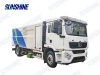

A road sweeper is a specialized vehicle used for cleaning roads,such as those in cities and highways.It uses a series of processes,including dust collection,vacuuming,and scrubbing,to remove dust,trash,stains,and other debris from the road.Road sweepers not only significantly improve road cleaning efficiency,but also reduce the workload of manual sweeping and effectively improve environmental quality.With the acceleration of urbanization and rising environmental protection requirements,modern road sweepers have gradually become a vital component of urban infrastructure.
▲Main Components
▲Cleaning System
The core component of a road sweeper is the cleaning system,which typically consists of multiple brushes and a suction device.The front of the vehicle is typically equipped with one to three sets of rotating brushes,which effectively push trash and dirt from the road surface toward the center of the vehicle.The rear of the vehicle is equipped with a suction device,which draws trash into an onboard trash can or dust box.The cleaning system design can be adjusted to suit different road types,such as city streets and highways.
▲Garbage Collection System
The garbage collection system on a road sweeper is responsible for storing the trash collected during the cleaning process.The collection bin is typically located at the rear of the vehicle and can be raised and lowered hydraulically for easy emptying.To improve efficiency,some high-end road sweepers feature automatic bin emptying,eliminating manual intervention.
▲Powertrain
Road sweepers typically use internal combustion engines,natural gas,or electric powertrains.Traditional road sweepers often use diesel engines,which offer high power but pose significant environmental challenges due to high emissions.In recent years,electric road sweepers have become increasingly popular,particularly in urban environments.Electric road sweepers are not only quiet and emit almost zero emissions,but also offer improved energy efficiency due to the high efficiency of their electric motors.
▲Cockpit and Operating System
The cockpit of a road sweeper is ergonomically designed,allowing the driver to easily control the sweeping and collection systems.Many modern road sweepers are equipped with intelligent operating systems that monitor vehicle operating status,cleaning performance,and waste collection status in real time.These systems also record data to assist management with daily maintenance and management.
▲Working Principle of a Road Sweeper
The working principle of a road sweeper is relatively simple,relying primarily on two processes:sweeping and vacuuming.First,the rotating brushes at the front of the vehicle sweep trash,fallen leaves,dust,and other materials from the road into a dust collection area in the center of the vehicle.A vacuum system at the rear then uses suction to draw this debris into a collection bin.Throughout this process,the sweeper may also be equipped with a spray system that applies a small amount of water or detergent to the ground to reduce dust and ensure effective cleaning.
Modern road sweepers are constantly innovating in terms of intelligence.Some models feature automatic control systems that automatically adjust brush speed and sweeping pressure to ensure optimal operation in varying road and weather conditions.
▲Advantages of Road Sweepers
▲Efficiency
Compared to traditional manual sweeping,road sweepers offer significant advantages in both speed and effectiveness.A single sweeper can achieve the same efficiency as dozens of manual sweepers,while providing a more uniform and thorough sweeping effect.
▲Environmental
With increasing environmental protection requirements,new energy road sweepers(such as electric sweepers)are increasingly gaining a dominant position in the market.Compared to traditional fuel-powered road sweepers,electric road sweepers not only have lower emissions and quieter noise levels,but are also more energy-efficient and environmentally friendly in long-term operation.
▲Pollution Reduction
With their dust collection devices,road sweepers can effectively reduce dust on the road,thereby reducing air pollution and positively impacting urban air quality.
▲Labor Cost Reduction
The use of road sweepers significantly reduces labor costs and human resource consumption,especially in large-scale urban cleaning operations.
▲Future Development Trends
With the increasing demand for urban road cleaning and increasingly stringent environmental regulations,road sweeper technology is continuously advancing.In the future,electrification,intelligence,and automation will be the main development directions.
▲Electrification
With the continuous advancement of battery technology,electric road sweepers will become the mainstream of urban cleaning operations in the future.Electric road sweepers not only effectively reduce pollution but also lower daily operating costs.
▲Intelligence
Road sweepers will integrate technologies such as big data and artificial intelligence,equipped with more intelligent sensors and automated control systems,to further improve cleaning efficiency and accuracy.
▲Automation
The application of autonomous driving technology will enable road sweepers to complete cleaning tasks without human intervention.Especially at night or during off-peak hours,automated sweepers can efficiently handle large-scale cleaning tasks.
▲Summary
As a vital component of modern urban infrastructure,road sweepers have become an essential tool for improving urban cleaning efficiency and environmental quality.With the continuous advancement of technology,new energy,intelligent,and automated technologies will become the main development directions for road sweepers in the future,contributing to the sustainable development of cities.
▲Company Introduction

Zhongke Shangsheng New Energy Vehicle Co., Ltd. specializes in the research and development and production of various new energy sanitation vehicles, including new energy garbage trucks, new energy sweepers, restaurant kitchen trucks, road sweepers, cleaning vehicles, water sprinklers, and dust suppression vehicles. The company currently operates a Yancheng R&D and processing plant and maintains long-standing partnerships with large and medium-sized sanitation companies, universities, and research institutes both domestically and internationally. The company has signed a long-term technical cooperation agreement with the Shanghai Branch of the Chinese Academy of Sciences, providing technical services and support regarding policies, regulations, standards, and market requirements, and jointly developing new technologies and processes for special-purpose vehicle modification. Focusing on the R&D direction of "electrification, intelligence, and connectivity," the company is focusing on new energy product development, product cost reduction, and the development of intelligent vehicle networking systems for sanitation equipment. The company is currently developing a small unmanned sweeper that incorporates intelligent obstacle avoidance, facial recognition assisted driving, and intelligent traffic light start-stop technology. The company has relocated part of its production and technical teams to Suizhou, establishing a standardized assembly line and implementing tooling-based production within the industrial park. The company assembles and manufactures various sanitation vehicles, with an annual production capacity of 800 units. To date, the company has 125 employees, including 92 front-line production personnel, and its output value in 2021 was 200 million yuan.
▲Industry Applications

▲Factory appearance

▲FAQ
Q. Where are road sweepers suitable for use?
A. Road sweepers are suitable for a variety of applications, including city streets, highways, parking lots, airport runways, and factory floors. They are particularly well-suited for areas requiring efficient cleaning and large-scale waste collection.
Q. How to operate a road sweeper?
A. Operating a road sweeper requires specialized training. Basic operating steps include starting the engine, adjusting the brushes and suction system, setting the sweeping mode, and starting the sweep. Modern road sweepers are typically equipped with electronic controls, making operation relatively simple, but familiarity with the operating details is still required.
Q. How does a road sweeper work?
A. A road sweeper uses brushes to sweep debris and dust from the road surface into a suction port on the front of the vehicle. Suction then sucks the dust into the vehicle's internal trash bin. Some sweepers are also equipped with a water spray system to suppress dust, ensuring a more environmentally friendly cleaning process.

.webp?x-oss-process=image/resize,w_100/quality,q_100)


Contact US
Product Information
Quantity
Unit
Piece
Support order samples, customization, wholesale direct, and complete payment. If the product you look for does not have corresponding customized content, pls fill out the form below to contact us, and we will reply ASAP.